
The Confidence To Go Bigger
By SAM ROOM, Ancasta Motor Yacht Specialist

How smart onboard technology, connected systems and intuitive design are making larger yachts easier to manage – and feel more like home.
A small first-time boat may be perfect for day trips and long weekend adventures, but as your confidence on the water grows, so does the desire for more space, greater range and a yacht capable of welcoming family and friends in greater comfort.
A larger yacht can offer a richer way of life on the water: longer passages, extended stays, more privacy, ample entertaining space, and a floating retreat that feels like a second home.
That next step may take many forms. For some, it is the move into a refined flybridge yacht such as the Prestige F-Line, where models are designed around generous living spaces, comfort and shared moments onboard. For others, it may be the appeal of passage making yachts such as the Beneteau Swift Trawler and Beneteau Grand Trawler ranges, where efficiency, range and practical comfort make longer-distance cruising feel more attainable.
For owners looking for space, stability and a more homely feel, large catamarans offer another route into a bigger boat. Lagoon’s larger multihulls, feature generous accommodation, privacy and long-distance cruising comfort, while high-performance builders such as McConaghy bring a different interpretation of the large catamaran: lightweight construction, sailing performance and expansive living space across models from 55ft to 86ft.
There is also a growing appetite for yachts that blur the boundaries between open day boat, cruiser and luxury weekender. The Bluegame BG range, including the BG42, BG54 and BG74, speaks to owners who want versatility, connection with the sea, and outdoor living.
Confidence-building technology
Yet moving up in size has traditionally come with hesitation. A larger yacht can feel like a significant step, not only in terms of cost, but in handling, systems management, and day-to-day logistics. The question is not only “Which yacht do I want?” but “Will I feel comfortable running it?”
Today, a new generation of onboard technology is helping owners to embrace larger yachts. Rather than making boats feel more complex, the best innovations make them feel more intuitive, manageable, and accessible for those who want to upsize without recruiting full-time crew.
At the centre of this shift is confidence. Yacht architects are increasingly catering for an owner-operator scenario. High-tech systems and clever design simplify manoeuvring, improve visibility, and reduce technical anxiety that can arise when managing a more substantial vessel.
For owners considering upsizing, these features can be transformative. The additional volume, accommodation and capability of a larger yacht become easier to enjoy when experience at the helm feels simple and controlled.
A central Ship Control Interface now allows many onboard functions to be managed from one digital hub. Lighting, air conditioning, sound systems, bilge pumps, battery levels and tank information can be viewed and adjusted through the helm screens or, in many cases, from a mobile app. For an owner stepping up from a smaller boat, this brings a sense of order to what might otherwise feel like a more complex onboard environment. Instead of moving between switches, panels and compartments, they can understand the yacht’s status at a glance. It brings the familiar logic of a smart home to life on board.
This sense of reassurance continues beyond the yacht itself. SEANAPPS technology, standard on newer models, gives owners real-time insight into key information such as location, battery condition and fuel levels directly from a mobile phone. It can also help schedule maintenance, turning technical upkeep into something more visible and manageable.
For owners moving into a larger yacht, where there are naturally more systems to oversee, that kind of connected support helps reduce uncertainty and makes ownership feel more straightforward.
Stay connected
Another important shift is changing not only how owners manage their yachts, but how they use them. The rise of remote and hybrid working has made time on board more flexible, allowing owners to extend weekends, work between destinations, or spend longer periods away without feeling disconnected from professional life.
In the past, stepping on board often meant stepping away from reliable connectivity. For some, that was part of the appeal. But for others, especially business owners, entrepreneurs and families balancing work, school and travel, limited internet access could restrict how often the yacht was used. Today, high-speed satellite connectivity is helping to remove that barrier.
Systems such as Starlink Maritime are bringing faster, lower-latency internet to yachts through low Earth orbit satellite networks. In practical terms, this makes video calls, cloud-based work, messaging, streaming, navigation updates and remote monitoring from the water possible. The result is a subtle but powerful change in how a yacht fits into modern life.
A morning meeting can take place from the saloon. Emails can be answered at anchor. Guests can stay connected. Families can extend their time away, and homeschooling at sea is possible. The yacht becomes less of a place one escapes to temporarily and more of a genuine floating home.
For owners considering a larger yacht, this can be particularly attractive. More volume creates the possibility of dedicated working zones, quieter cabins, better separation between guests and family, and longer stays on board.
This kind of technology also changes the psychology of ownership. When owners know they can remain reachable, monitor responsibilities and continue working when required, they may feel more comfortable using the yacht spontaneously and for
longer periods.
Control at the helm
Just as connectivity makes life on board more flexible, advances at the helm are making larger yachts feel more manageable. Handling has seen an equally important evolution. Joystick manoeuvring systems, including Volvo IPS and Cummins joystick controls, have made low-speed operation far more intuitive. In place of traditional throttle and wheel inputs alone, the yacht can be guided with simple, precise movements, moving sideways into a berth or rotating within a confined space.
Supported by bow and stern thrusters, this technology helps remove one of the greatest psychological barriers to upgrading: the fear that a larger yacht will be difficult to berth.
Assisted docking systems take that confidence further. Dockmate™ provides precise remote control of steering, throttle, engines, and thrusters, helping skippers to navigate nearby obstacles and tight spaces.
While Garmin Surround View provides a 360-degree visual picture around the yacht, helping to reduce blind spots and support safer, calmer close-quarters manoeuvring. These features don’t replace seamanship; they support it. They allow owners to develop skills and confidence with a greater margin of comfort.
The freedom to move up
Accessibility in yachting is not only about control systems and technology. It is about how people feel on board. For those upgrading, a larger yacht is rarely about size for its own sake. It is about lifestyle: inviting more people, staying away for longer, working when needed, and enjoying plenty of downtime.
Across the market, from the Prestige F-Line to Beneteau’s Swift Trawler and Grand Trawler models, from large Lagoon and McConaghy catamarans to the Bluegame BG range, the same theme is becoming clear. The latest yachts are not simply offering more space, more range or more dramatic design. They are being shaped around how owners actually want to live: connected, independent, flexible, and confident.
In the end, innovation at sea is not measured only by what a yacht can do. It is measured by what it allows its owner to do. To move up a size with confidence. To leave the berth without anxiety. To enjoy more space, more range and more time on board. To create a better balance between work and play.


Contact
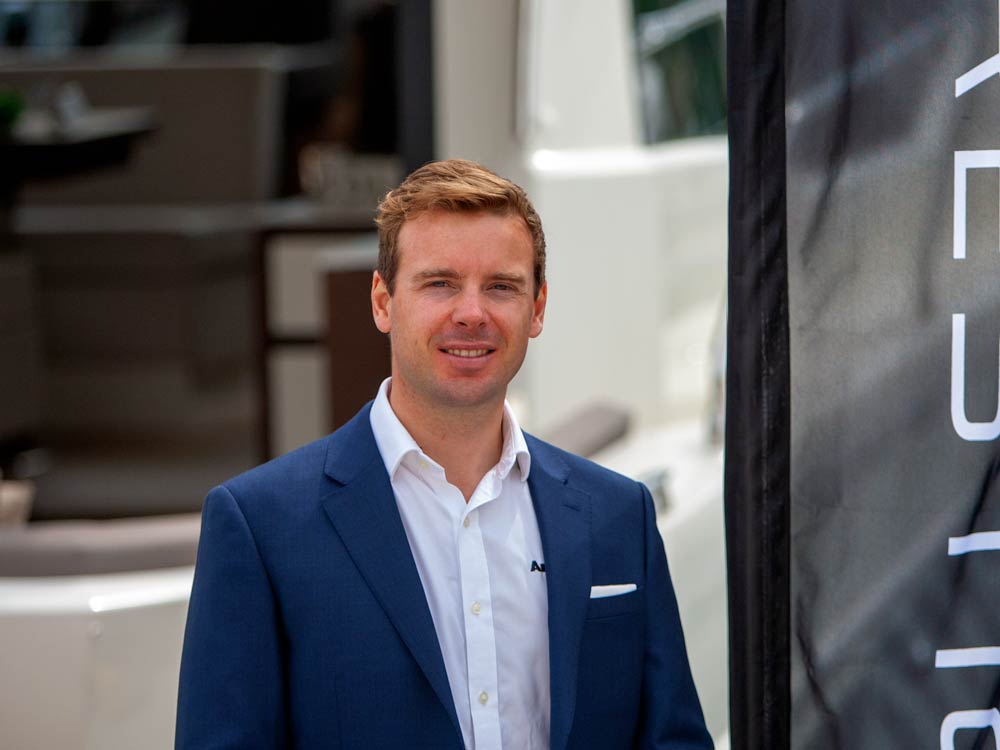
For more information, contact: Sam Room
Prestige Brand Manager
Sam has spent a lifetime on the water from dinghies at a young age through to yacht racing whilst at Edinburgh University. Prior to joining Ancasta, Sam worked as deck crew onboard a super yacht travelling all over the Mediterranean, Caribbean and the Bahamas racking up three transatlantic crossings.
For the past few years, Sam has been managing the busy brokerage office in Port Solent as well as being a key member of the Prestige Yachts sales team.
As a qualified yacht master, keen kitesurfer and windsurfer, he is at home by the coast and in his role as Prestige Brand Manager, would be delighted to help you to explore the extensive Prestige Motor Yacht range.
+44 (0)2380 450 000
[email protected]